Indian MSMEs face structural barriers accessing export-import finance and FTA benefits despite numerous government schemes
Indian MSMEs face structural barriers accessing export-import finance and FTA benefits despite numerous government schemes
The Silent Bottleneck Holding Back India's Global Trade
India does not lack export–import finance schemes.
India does not lack trade agreements.
India does not lack policy intent.
What India lacks is last-mile execution.
Despite dozens of schemes from the Government of India, RBI, EXIM Bank, ECGC, and public sector banks — and despite multiple Free Trade Agreements (FTAs) — the majority of Indian MSMEs are structurally unable to access, apply, and benefit from these advantages.
This is not a funding problem.
It is a system design problem.
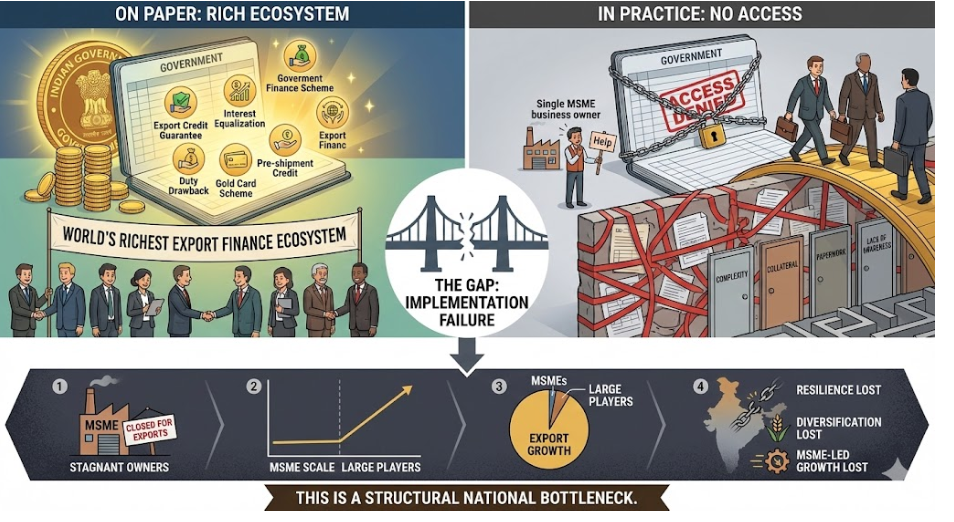
On paper, India has one of the richest export finance ecosystems in the world.
In practice, most MSMEs never fully benefit.
As a result:
MSMEs don't enter exports
Existing exporters don't scale
Export growth remains concentrated among large players
India loses diversification, resilience, and MSME-led growth
This is a structural national bottleneck.
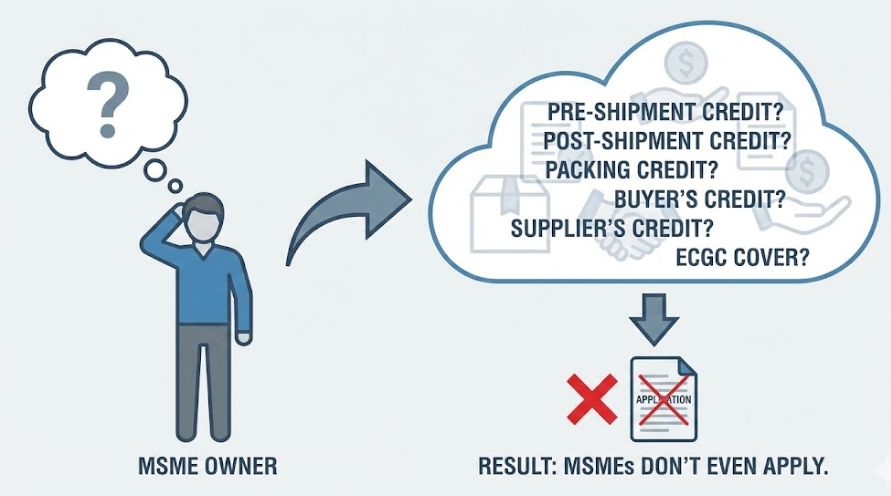
Most MSMEs:
Don't know which scheme applies to them
Don't understand the difference between:
Pre-shipment credit
Post-shipment credit
Packing credit
Buyer's credit
Supplier's credit
Are unaware of ECGC cover requirements
Result:
MSMEs don't even apply.
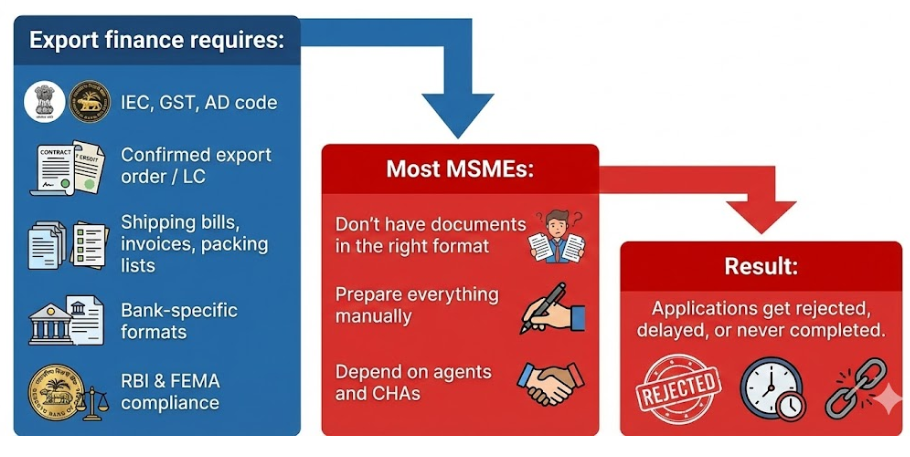
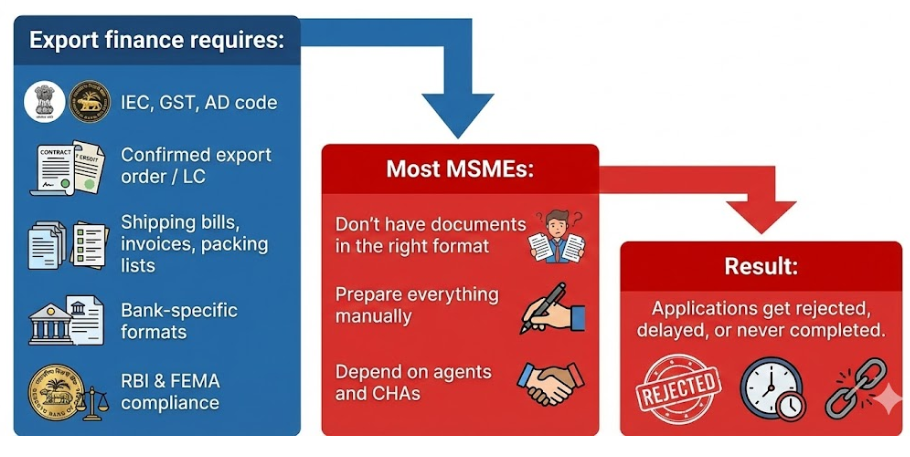
Export finance requires:
IEC, GST, AD code
Confirmed export order / LC
Shipping bills, invoices, packing lists
Bank-specific formats
RBI & FEMA compliance
Most MSMEs:
Don't have documents in the right format
Prepare everything manually
Depend on agents and CHAs
Result:
Applications get rejected, delayed, or never completed.
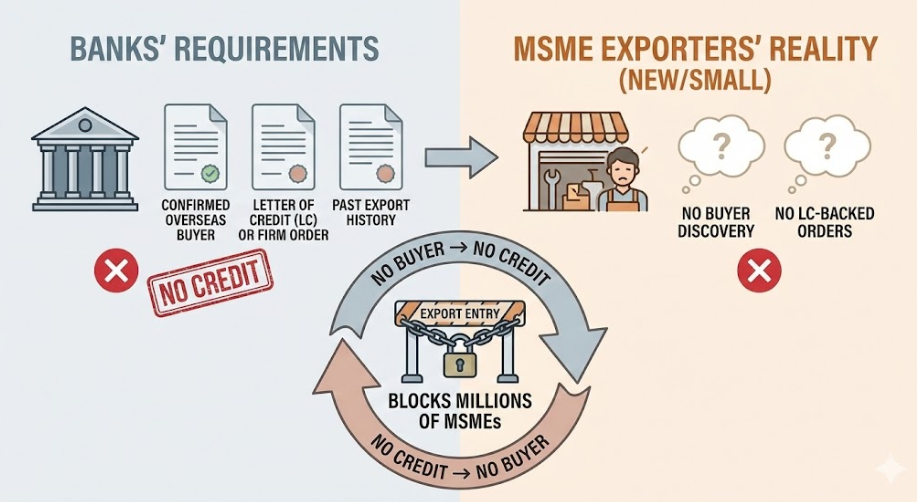
Banks usually ask for:
Confirmed overseas buyer
Letter of Credit (LC) or firm order
Past export history
New or small exporters:
Don't have buyer discovery
Don't have LC-backed orders
Result: No buyer → no credit
No credit → no buyer
This single loop blocks millions of MSMEs from entering exports.
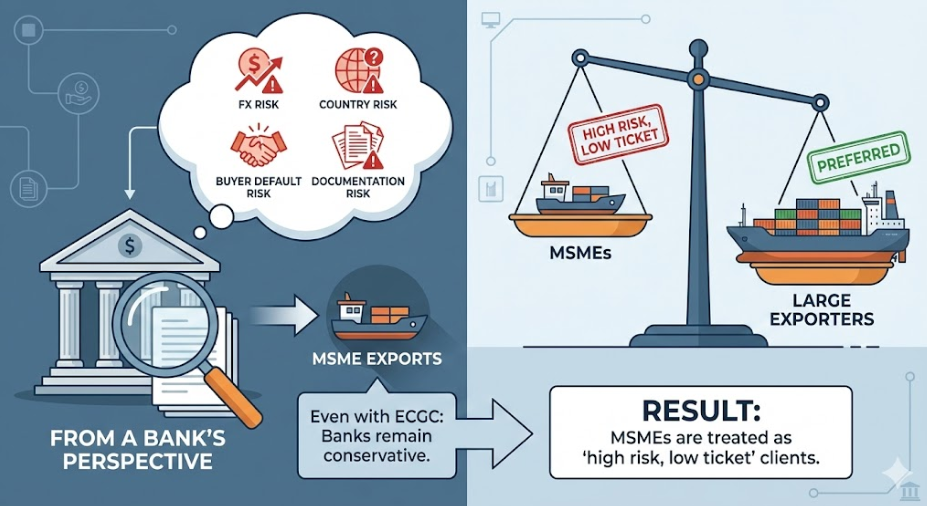
From a bank's perspective:
MSME exports = higher FX risk
Country risk
Buyer default risk
Documentation risk
Even with ECGC:
Banks remain conservative
Prefer large, repeat exporters
Result:
MSMEs are treated as "high risk, low ticket" clients.
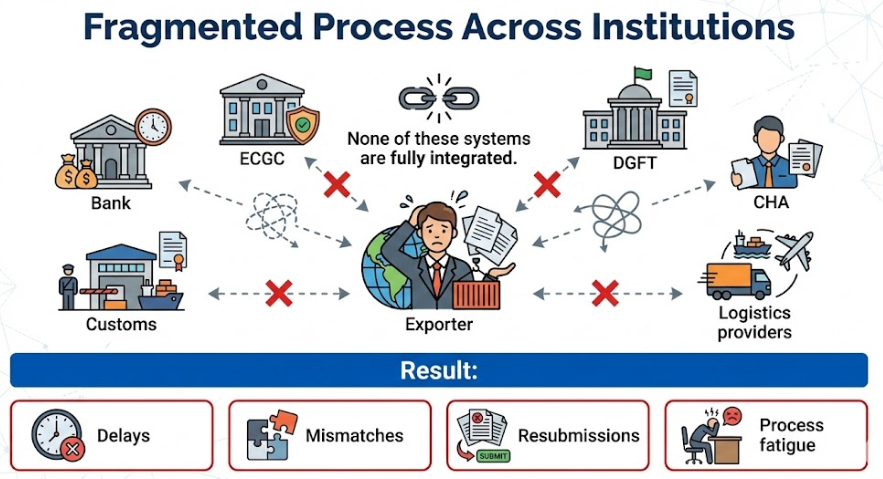
An exporter must coordinate with:
Bank
ECGC
DGFT
Customs
CHA
Logistics providers
None of these systems are fully integrated.
Result:
Delays, mismatches, resubmissions, and process fatigue.
Even when approved:
Pre-shipment credit is delayed
Post-shipment realization is slow
GST & drawback refunds take time
Result:
Working capital stress.
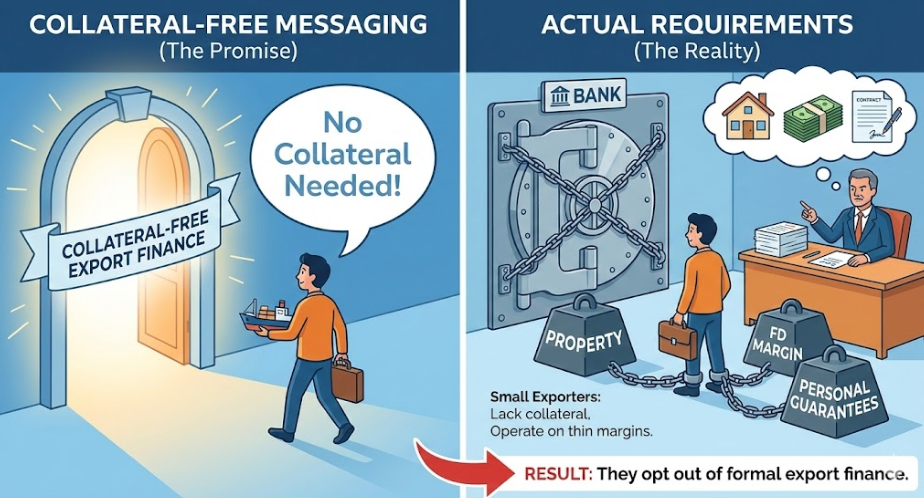
Despite "collateral-free" messaging:
Banks often still ask for:
Property
FD margin
Personal guarantees
Small exporters:
Lack collateral
Operate on thin margins
Result:
They opt out of formal export finance.
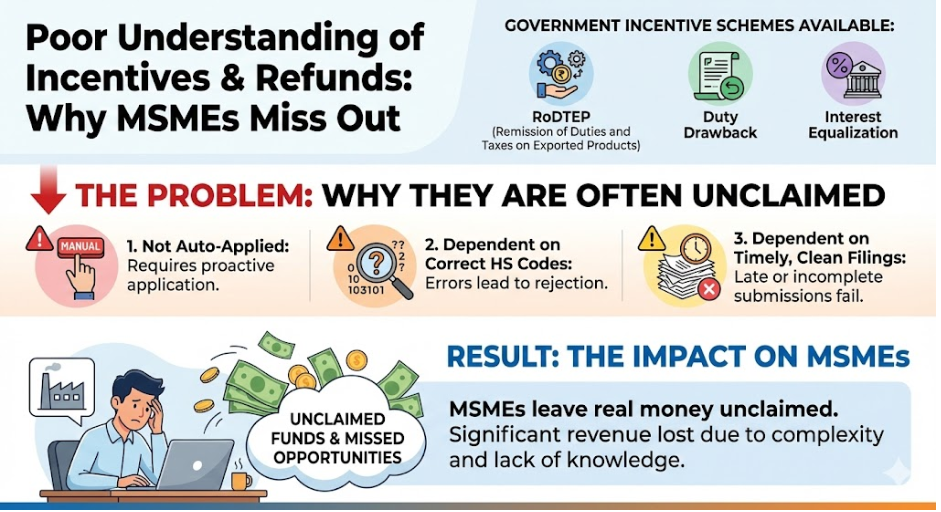
Schemes like:
RoDTEP
Duty Drawback
Interest Equalization
Are:
Not auto-applied
Dependent on correct HS codes
Dependent on timely, clean filings
Result:
MSMEs leave real money unclaimed.
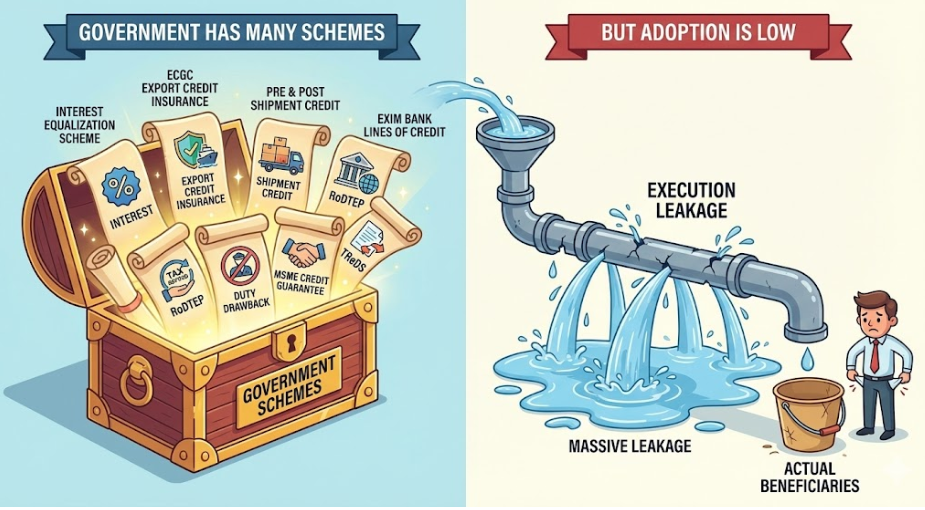
Major schemes include:
Interest Equalization Scheme
ECGC export credit insurance
Pre & Post Shipment Credit (RBI-regulated)
EXIM Bank Lines of Credit
RoDTEP
Duty Drawback
MSME Credit Guarantee schemes
TReDS (invoice discounting)
Yet execution leakage remains massive.
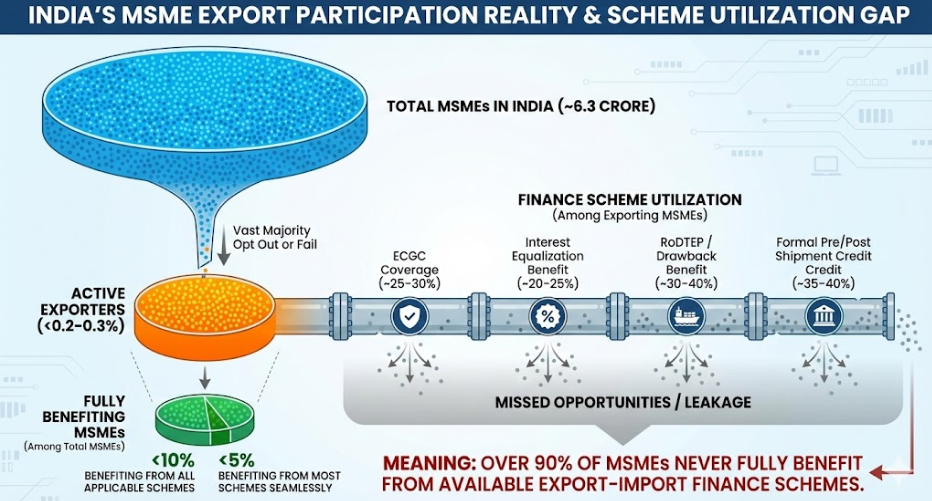
Export Participation Reality
~6.3 crore MSMEs in India
Less than 0.2–0.3% are active exporters
Finance Scheme Utilization (Broad, Conservative Estimates)
Among exporting MSMEs:
ECGC coverage: ~25–30%
Interest Equalization benefit: ~20–25%
RoDTEP / Drawback fully claimed correctly: ~30–40%
Formal pre/post shipment credit access: ~35–40%
Among total MSMEs:
Benefiting from all applicable schemes: less than 10%
Benefiting from most schemes seamlessly: less than 5%
Meaning:
Over 90% of MSMEs never fully benefit from available export–import finance schemes.
Schemes are information-rich, execution-poor
No auto-eligibility mapping
Poor data quality blocks automation
Too many intermediaries
Manual, PDF-driven workflows
No integrated trade + finance + compliance systems
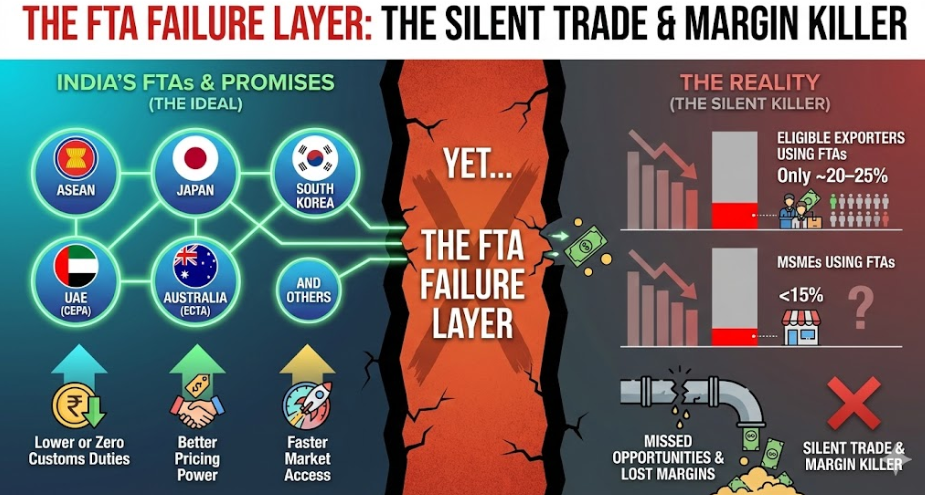
India has signed multiple FTAs to boost competitiveness:
ASEAN
Japan
South Korea
UAE (CEPA)
Australia (ECTA)
And others
These offer:
Lower or zero customs duties
Better pricing power
Faster market access
Yet…
Only ~20–25% of eligible exporters use FTAs effectively
For MSMEs, less than 15%
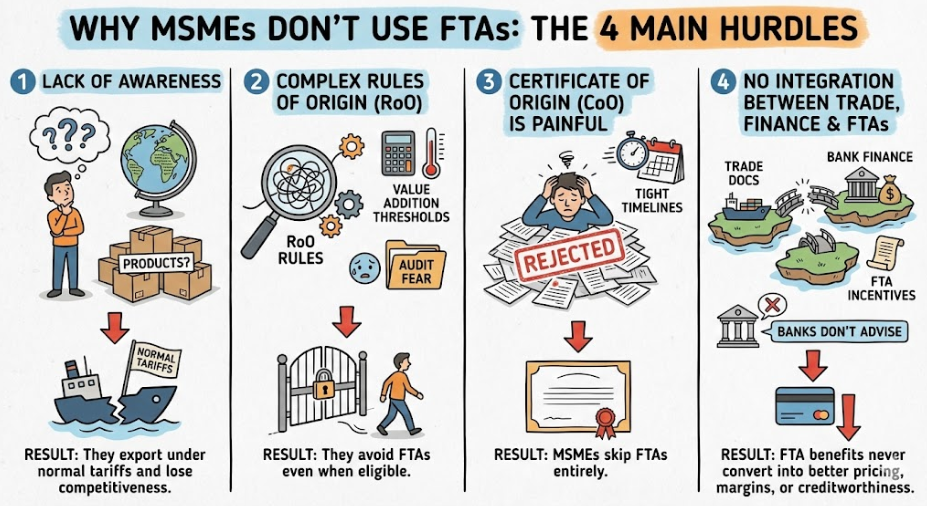
Don't know which FTA applies
Don't know which products qualify
Don't know duty benefit value
Result:
They export under normal tariffs and lose competitiveness.
Product-specific RoO
Value-addition thresholds
HS-code-level compliance
MSMEs:
Don't understand RoO
Don't track value addition
Fear audits and rejection
Result:
They avoid FTAs even when eligible.
Manual application
Error-prone documentation
Rejections common
Tight timelines
Result:
MSMEs skip FTAs entirely.
FTA usage is disconnected from:
Export documentation
Bank finance
Incentive workflows
Banks:
Don't proactively advise on FTAs
Don't link FTA benefits to credit
Result:
FTA benefits never convert into better pricing, margins, or creditworthiness.
FTA requires:
Accurate HS codes
Correct origin declarations
Clean BOM and invoice data
MSMEs submit:
PDFs
Inconsistent formats
Manual documents
Result:
Even eligible exporters fail audits or face rejection.
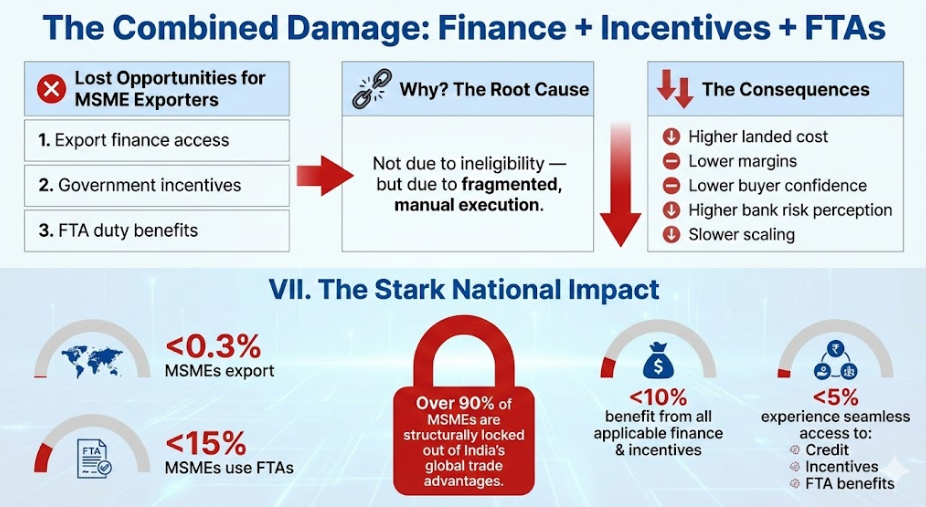
Today, an MSME exporter often loses simultaneously:
Export finance access
Government incentives
FTA duty benefits
Not due to ineligibility — but due to fragmented, manual execution.
This means:
Higher landed cost
Lower margins
Lower buyer confidence
Higher bank risk perception
Slower scaling
Conservatively:
less than 0.3% MSMEs export
less than 15% MSMEs use FTAs
less than 10% benefit from all applicable finance & incentives
less than 5% experience seamless access to:
Credit
Incentives
FTA benefits
Over 90% of MSMEs are structurally locked out of India's global trade advantages.
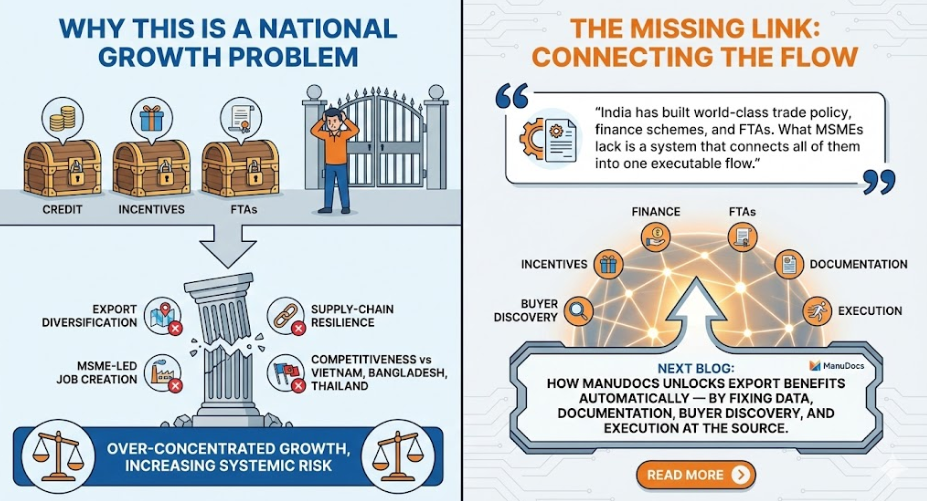
When MSMEs can't access:
Credit
Incentives
FTAs
India loses:
Export diversification
MSME-led job creation
Supply-chain resilience
Competitiveness vs Vietnam, Bangladesh, Thailand
Export growth becomes over-concentrated in large players, increasing systemic risk.
"India has built world-class trade policy, finance schemes, and FTAs.
What MSMEs lack is a system that connects all of them into one executable flow."
This sets up your next blog perfectly:
How Ximverse unlocks export finance, incentives, and FTA benefits automatically — by fixing data, documentation, buyer discovery, and execution at the source.